Blog Details
Flutter or React Native in 2026? How We Choose
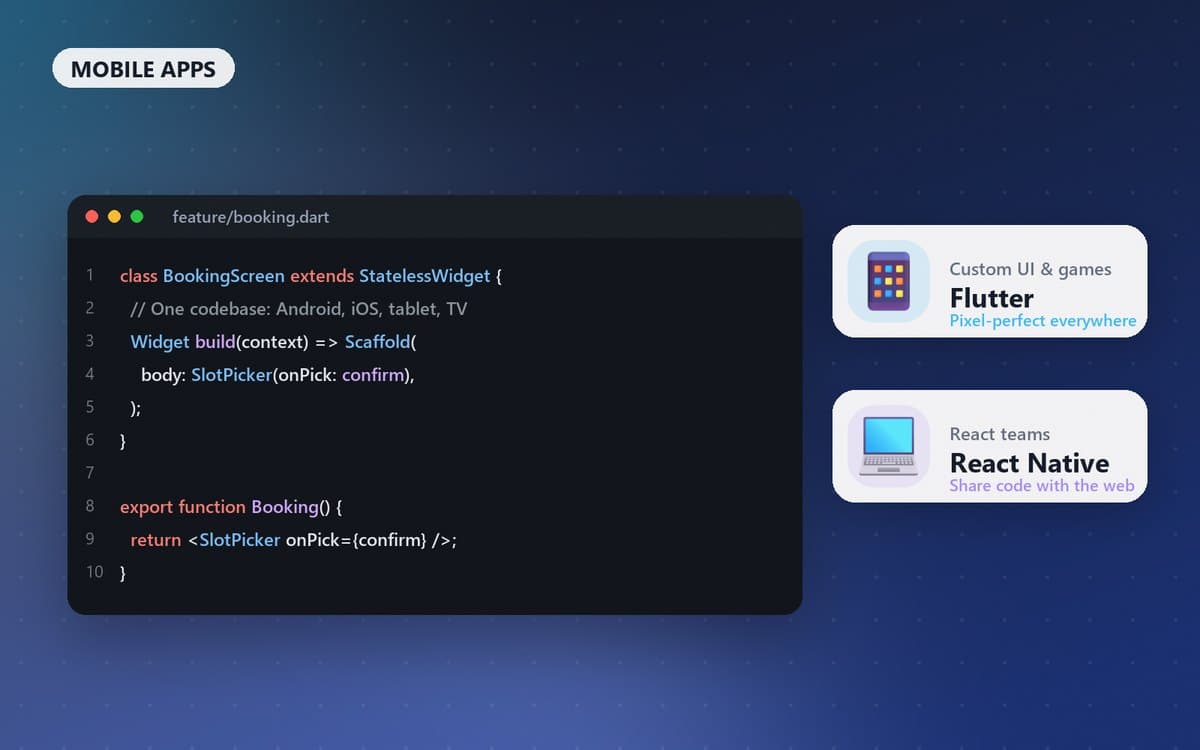
Clients often ask whether they should build their app in Flutter or React Native. Both let you ship Android and iOS from a single codebase, both are mature, and both power well-known apps. We have built most of our recent apps, including Ankur, Khelora Ludo, DoseWise, CityCare and SuitClash, with Flutter, and we work in React Native too. Here is how we choose.
Where Flutter shines
- Custom, polished interfaces. Flutter draws every pixel itself, so a design looks the same on every phone. That is ideal for games, children's apps and branded experiences.
- Animation and graphics. Board games, puzzles and playful interfaces are natural in Flutter.
- Offline-first apps. With a local database, Flutter apps work smoothly with no network, which matters a lot in India.
- One codebase for more screens. The same code can target phones, tablets and even Android TV, as we did with Ankur.
Where React Native shines
- Your team already knows React. Web developers can move to mobile quickly and share logic with a React or Next.js website.
- Native look by default. Standard platform controls feel at home on each OS.
- Large JavaScript ecosystem. Many libraries, especially for web-style features.
The questions we ask
- Is the design highly custom or standard platform UI?
- Does the app need games, rich animation or a TV version?
- Will it work offline, or is it mostly online forms and lists?
- Does your team, or a future team, already work in React?
- Do you also need a website that should share code with the app?
Our honest recommendation
For most new consumer apps, games and offline-first apps, we recommend Flutter. If you already have a React web product and a React team, React Native can be the faster path. Either way, the framework matters less than good architecture, testing and a clear product plan.
Not sure which is right for your idea? Send us a short description and we will recommend a stack, with a timeline and estimate.